Wednesday, 4 July 2012

The Best Bar in Japan

When you come across a truly great bar you’re naturally reluctant to share it with anyone else. It’s with a certain amount of hesitation, then, that I want to introduce the magical and idiosyncratic world of Danke Schon.

The Magic That is Danke Schön

A few minutes walk from JR Funabashi station, Danke Schon is a German bar which has, since 1983, been serving top-quality imported beers and hearty fare to the good folk of Funabashi. Run by the charismatic and super-friendly Okawara-san, a Funabashi native and former Lufthansa (German national airline) sales employee, Danke Schon is an establishment which, from the first time I ventured there, pulled on my heartstrings. Great beer – the glorious Bitburger, Guinness and Heartland on tap, Becks, Lowenbrau and Erdinger in bottles and an amazing selection of handmade sausages such as Nurnberger, Chorizo and Thuringer (made by an 80 year-old German man based in Atsugi, Kanagawa prefecture), make it, in my humble opinion, one of the best bars in the world. It’s a big claim but after many years and many, many great nights spent there it seems more than justified.


Meister Okawara und Fraulein

Okawara-san, whose cheerful face graces the bar’s façade and menus, welcomes everyone with a friendly Guten Abend! (German for Good Evening!) and sets about making you feel instantly at home. The locals, too, never fail to make you welcome with polite chit-chat whilst genuinely taking an interest in where you are from and what you’re doing in Japan. Never intrusive it’s the perfect balance of hospitality and hand-picked, quality products which make Danke Schon such a local treasure. It’s also meeting the legion of regulars, who come from far and wide, that makes me feel like I’m not alone in my adoration of this place. 


Es Ist Sehr Gut

The interior, which has never changed since opening in the 80s, can only be described as enchanting. It resembles, what I imagine a German grotto to look like – wooden tables and seats, postcards from Okawara’s frequent visits to Munich and other places in Germany, authentic German beer steins, all topped off with a real, functioning cuckoo clock. It’s surreal, but in a nice way.


You’ll be glad to know the drinks menu isn’t restricted to beer. The bar has a healthy selection of standard cocktails, beer cocktails, whisky, schnapps and German wine - with the delightfully named Franken Wein being a particular favorite with the locals. The food menu also includes some gems such as German potato, beef stroganoff, spare ribs, leberkase and sauerkraut as well as other snacks and meals.


If you hit the jackpot you might make it on the special nights when Okawara-san decides to treat the patrons to a huge glass boot filled with beer – passed down the bar while everyone sings German drinking songs intermixed with delirious cheers. The scene wouldn’t be complete without Okawara-san donning his traditional German feathered cap and ringing a bell attached to the end of the bar. It‘s quirky but it’s what Danke Schon’s about. Forget the polished pretentiousness of bars in Aoyama and Nakameguro and the sleazy sports bars of Roppongi. Danke Schon is a real bar where real people go – not to be seen or to be fleeced, but to be at one with your neighborhood and neighbors and to finally feel like you belong.  


Danke Schon: Honcho, Funabashi-shi 4-16-33
ダンケシェーン - 橋市本町4-16-33
Map: http://goo.gl/maps/eNZt

Thursday, 28 June 2012

Funabashi Hot Spot

As you would expect in major cities like Tokyo and its greater regions, it can be fairly challenging to find places to get away from it all and relax. However, one of the best places for a decent unwind around town is at an onsen. These are natural hot springs that pump water from deep below the earth into communal bathing areas. Though a lot of newer onsens have a manufactured feel, they do offer the chance to get away from the madness of the daily grind, giving you time and space to sit back and let the world flow gently by.


In Funabashi, there is such a place: Funabashi Houten no Yu (FHY). It is situated only a short walk from Funabashi Houten station and is a perfect place for alleviating the stresses of urban living.

Fossilized Amphibian Artwork


FHY has a decent selection of baths and has a particularly nice outside area where you can experience many different relaxation spots. I went on Sunday, which was, unsurprisingly, very crowded. Even some of the smaller baths had 7 or 8 people in them. This was OK though as bathers tended to rotate quite regularly. Among the various baths there are some iron spherically-shaped tubs called goemonburo (named after a Robin Hood style outlaw who was boiled to death for his exploits), a roofless flat bath with hot water only covering the surface (great for staring at the sky), a partially roofed two-tiered bath lined with rocks with rusty iron-enriched water, several lie-down jacuzzis with cold pipe headrests, and lots of chairs and benches for kyuukei (taking a rest); actually I often find sitting on one of these the most enjoyable part of the onsen experience - almost like sitting on a deckchair at the seaside! 


Goemon (+ Son) in Pot


If you’re thinking of going to an onsen, and it's your first time, it's good to be aware that you will be, save for small head-covering towel, completely free of clothing. Being a foreigner, you occasionally get “curious” looks. I often catch someone staring at me if I look up suddenly. This is mainly from young kids (genuine curiosity) and some of the older guys. The looks can feel a little charged but you do get positive vibes from time to time. I’ve chatted with other bathers at onsens before – not always the best place for it but nice to know you’re not completely unwelcome. 


Outside (Not FHY, but you get the picture)


After an hour and a half of outside bathing, steam room, jacuzzi, sauna and cold bath, and a good scrub down at your own personal sit down shower, you will feel like you've had a pretty decent session. After your bath, you can visit the restaurant serving reasonable quality food, and you can grab a beer too. I just went for a small bottle of milk for ¥100 from the vending machine in the locker room, which refreshes like nothing else. 


Kyuukei


There are separate male and female resting areas outside the changing rooms, places where you can get a personal massage (a little expensive) or use a massage chair or foot massage (¥100 for 10 minutes), and an area where you can sit and relax and grab a few ice cold glasses of water if you’re waiting for someone. 


The lighting and the music here are very calming and there are simple art works and plants scattered around the place, adding to the peaceful ambiance. From the moment you walk through the door until the moment you leave it is a very relaxing experience. If you go there at certain times you can find it pretty empty (mornings and afternoons on week days are your best bet). I had the place practically all to myself once. Was probably the most relaxed I've ever felt in Japan.


Funabashi Houten no Yu
5 minutes walk from Funabashi Houten (JR) station
船橋法典駅(千葉)

Wiki: http://tinyurl.com/bmjmekz (Japanese)

 Mon-Friday: ¥700 (adults)
 Weekends: ¥750

 http://goo.gl/maps/tGWC


Tuesday, 5 June 2012

Strange Bar

If you’ve ever been to or have lived in Japan you probably have come across a fair bit of quirkiness on your travels. I’ve found this to be true for some of the bars and restaurants I’ve visited over the years. One such place exists in Motoyawata and is well worth a visit if you are either a connoisseur of fine beers or a fan of the unusual.

 
Front of Strange

The bar in question: Orange Corn (おれんじCorn). If you thought that name was puzzling enough, when you discover that it goes by the more mysterious moniker of Strange Bar, you’re well on the way to bafflement.


Now, I have been to some quite ‘interesting’ places while living in Japan, for example a cosplay joint that, well, is designed like the Joint - you sit in a cell, handcuffed (if you choose), while served by armed female prison guards. And then there was the Japanese, Indian curry shop where, after hanging your coats up on fake finger hooks, they bring you the menu on a miniature globe and then discard the order entirely to bring you something of their own choosing…while singing karaoke. Strange indeed. Anyway, before this all starts getting a bit too weird, I’d like to point out that Strange Bar is really not all that strange. It’s a little out there, yes, but not in a bad way.


First, it has the most amazing range of beers. About 100 types in total are always at hand, but this increases to 120-130 when the owner has been on his travels and has picked out the cream of the best beers from the countries he's visited. The majority of beers served are foreign; Belgian beers mostly, then American and German, but there is also a great selection of Japanese beers. I tend to go for the German and Belgian beers, though if you really dig deep, you can find a beer perfectly suited to your taste. 


There’s the über-strong (8.5%) import Doppelsticke from Dusseldorf, Scottish Traquiar beer from a brewery established in the 18th century, and a Lenny Bruce memorial beer named He’Brew R.I.P.A to name but a few. The beer I’m trying for you today* is Kapuziner Weisbier from the Kulmbacher brewery in northern Bayern. As I’m sipping away, the Master explains a bit about the origin and the popularity of the beer. The explanation is all in Japanese, but I get the drift. Price: 700yen for a 500ml can; actually the prices here are very reasonable compared to other places that charge exorbitant prices for foreign tipple.


The quirkiness in the bar comes from the multitude of puzzles and games that occupy the counter, the selection of cheesy 80s music in the background, the Budweiser bandana clad Master (Hiraiwa-san), who hovers patiently, eager to serve you blocks of quality cheese on plates of lettuce or giant asparagus shoots sprinkled with katsuobushi (dried fish flakes), and the self-service from large refrigerators packed with all kinds of special brews.

Help Yourself

One thing Strange does is avoid the drag of gassy, chemically tasting draft beers you get all too often in your average bars. I have, on the odd occasion, in the middle of a drinking session, found myself unable to finish my pint. It gets too sickly by the end. Not so, however, when you’re supping on a quality German brew like Paulaner or Bitburger, or a Stella or Hoegaarden from Belgium. 


This is only a small bar but it’s very cosy. There are usually a few people in there sitting at the bar chatting to the Master or chilling with friends. I often end up at Strange with the other contributor to this blog. It’s a real treat that you can go somewhere after normal hours (it’s open until at least 2am) to drink this quality of beer. The Master’s encyclopedic knowledge of his stock is also a massive draw for us, as it’s a comfort to know that beer will be chosen by him very accurately for your particular taste. 

Beer Maps
 
There’s a decent food menu too, including a variety of dishes such German sausage, omelets, and pasta. You can also order something lighter like a salad or a variety of snacks (including packets of crisps), but you get something with the beer anyway so this is usually enough.


Whenever I get the chance to return to the UK, I often end up in a country pub drinking quality ale while chatting to my friends about this crazy old world. Even though there are a fair share of British style pubs in Japan, thus far, Strange has come the closest to offering this experience. It’s certainly a good way to educate yourself about what a decent brew is. There’s no doubt this place will help you discover quality over quantity, though there’s no guarantee that you will leave without getting a decent fill.

Library

*Oh the sacrifices I make for this blog :) 


Strange Bar (おれんじCorn, 千葉県市川市南八幡)

3-8-12 Minamiyawata, Ichikawa, Chiba Prefecture. 047-378-3407.

On foot: 5 minutes walk from JR Motoyawata Station
http://goo.gl/maps/EA7z

Wednesday, 23 May 2012

In Search of the Holy Ramen


One of the benefits of being a teacher in Japan is that you meet new students all the time and from that you often get recommended new places to visit. At the start of each school year, I do a self-introduction, giving basic info about myself – facts about country of origin, life in japan, likes and dislikes, that kind of thing. The things I most enjoy talking about is my favourite and least favourite foods – an easy attention getter in any language. 

One of my favourite foods in Japan is miso ramen (Chinese noodle dish adopted by the Japanese in a similar way that curry was by the British). There are many different types of ramen, and I like most of them, but miso flavour has always been the dish of choice.

Scenario: Classroom full of 30 new students.

“I like ramen”, I say.

Students: “heeeeeeeeeh” (Many connotations, but basically "Oh, wow.") the standard response.

“I love miso ramen”, I continue. “Do you like miso ramen?" (leading question).

Either silence or excited muttering to each other in Japanese. “So, if you know any good ramen shops, please let me know!” It's a sure bet saying this to a room of 30 people that someone has the information I'm after.

“Hands up who likes miso ramen”, I urge. 

Maybe one or two hands, even though a lot more probably do. Anyway, I get names and places. This year I had a student approach me after the lesson especially to tell me that she knew of a good miso place in Motoyawata (10 minutes from my apartment). Great! After getting a bit excited about a new place to explore, I realised that I had been there once already (often the case with ramen restaurants). But since I've started writing this blog, I thought I'd give it another go. Any excuse.


The weather was awful but I persevered. Nothing that a warm ramen can't sort out! The shop is around two minutes walk from Motoyawata JR station. Name: Gaten. Apparently this place gets so busy sometimes that you have to make reservations. Not so today though, as the weather and the timing (about 5pm) put paid to that.

As with a lot of ramen restaurants in Japan there is a system where you buy tickets from a machine as you walk in (good for getting people in and out quickly). The machine, all in Japanese, took a bit of working out as my kanji reading skills are not all that good. However, I found the miso + char siu (Chinese barbecued pork) without much bother. 

So, one of those, a small bowl of rice, and a large bottle of Kirin beer (heh, go large, why not?). ¥1500 in total. A gentlemen came to collect my tickets and showed me to my seat at the back. The place was pretty empty and I could have chosen to sit in a slightly bigger area that is raised and seats around six but I went for a table for two. 


The waiter brought me my oshibori (hand towel), water, and beer and I sat back and perused the joint. Nice place, quite spacious, with plenty of light and some not too intrusive J-Pop playing in the background. Also there were some pictures colored in by local kids on the walls. It gave the place a nice feeling, which is unlike some ramen restaurants that are akin to run-down greasy cafes and have little in the way of atmosphere.


The food arrived. This was a standard miso ramen with char siu pork, with egg, menma (bamboo shoots) and sweetcorn topping. I used some of the condiments – spoonful of garlic, dabble of red-hot chill sauce, and black pepper. These are perfect for some extra tang. There are other things such as shouyu (soy sauce), shijimi (dry red pepper), and white vinegar, but these are mainly used for other dishes which are plentiful on the menu here. 


I requested the soup abura (fattiness) be futsu (regular). The dish came with the usual sprinkling of pork fat on the top (doesn't sound too appetizing but it really does complement it). The meat was cut thin and was a little fatty, but melted in the mouth perfectly. Combined with the rice and the beer, it went down very well. I'll definitely come here again and will bring people with me. I have been to other places in Motoyawata that have different combinations of toppings that I prefer and a slightly thicker soup and thicker meat, but this was by no means a disappointing dish. 


You can pick up dedicated ramen magazines at convenience stores that review most places in your local area and I will be checking the closest one to me in search of the perfect ramen feast. In the meantime though, I'd come here again and definitely with friends so we can enjoy the experience together.

I'm seeing the student tomorrow that gave me the information about Gaten. She'll be very pleased that I give it a enthusiastic “oishiiii!” when she asks how it was.

Directions: http://tinyurl.com/7qkk3gq


Tuesday, 15 May 2012

A Leisurely Sunday (pt.1)


In the Onitaka area, located at an approximately equal distance north of Shimosa Nakayama, Nishi-Funabashi, and Motoyawata, there is a place worth visiting when you're in the wandering mood: Shochuzan Hokekyo-ji Temple.

Five-Storey Pagoda
This is the famous temple where the influential monk Nichiren Daishonin resided in 1265 – his teachings are one of the fundamentals of Buddhist religion still influencing Japanese society today. Many of his original scriptures are still housed there, including the "Conversation Between a Sage and an Unenlightened Man", which contains the Zen teachings of 'the finger pointing to the moon', and after an hour or so there you can sense the “heavenly glory” all around you.

This is where I used to escape for some peace and quiet when I first came to Japan, away from all the people and the concrete that can sometimes get a little oppressive. In the UK, I had attended some Buddhist meditation classes and my teacher, a beautifully radiant woman named Vicky, had predicted I'd live in Japan and visit such a place. I'm not superstitious or religious, but she got it spot on, and this temple became a wonderful retreat for me in my first few years living here.


Sandals Drying on Temple Gate

The temple is a perfect place to clear your mind. The walk up the partially steep hill is well worth it, as you pass many atmospheric, small businesses and shops on the way, ranging from yakitoriyas (selling various grilled chicken parts on sticks) and family run izakayas (a traditional Japanese restaurant and drinking establishment), green tea shops, souvenir shops and the like, and a very nice stop off point, which is a small garden with sheltered seating area where you can sit back and listen to the birds tweeting playfully at the placid temple cats. It feels like this garden is placed perfectly halfway up the hill. This is no fluke. Someone's actually thought this through. 


You quickly find yourself at the top of the hill and at the San Mon (temple gate). This grand entrance, staring down at you the with menace and welcome at the same time, is a sight to behold. The two large demonic guards each side of the gate leave you a little in awe, and it's hard not to get the feeling that you won't be bumping into any bad spirits once you cross the threshold. Comforting.


San Mon (Temple Gate)


The walk down to the main area is equally as nice. The downward slope really does throw you into a bit of a time warp. I brought some friends down here just after dusk one time. There is a Kendo school off to one of the sides. Seeing that there, tucked away, brought up all sorts of imagery – secretive, exclusive dojo with a handful of picked students attaining mastery of this ancient art! Even if you're not into that kind of thing, it certainly adds to the atmosphere.

Walkway Down to Main Area

Seating Outside Cafe

There are some beautiful reds and greens in this area at the moment (even after the cheery blossom season, there's still plenty to enjoy). While you're in the temple there are a few things that you can experience. My favourite is a quick prayer to the medium size but utterly serene and majestic seated Buddha. It's hard not to get a sense of wonder and peace from this beautiful statue. A brief stop and bow usually do.

Statue of Buddha

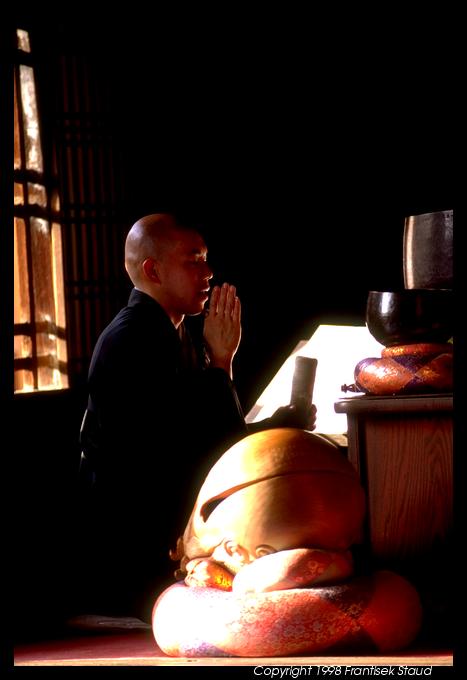
Then it's off to get smoked. There are the usual temple routines of Joukorou (smoke purification), Chozuba (water purification), and Kane (money toss, bell ring, clap, and prayer) at the Daido (Main ceremonial building). Even for non-religious people, it's fun to participate in all these rituals. I like that about Buddhism - it's not that there aren't any rules, just that you can take it completely in your stride.


Daido (Great Hall)


What I find really amazing though is the chanting of the Sutras by the temple monks. If you haven't heard this, you really must try to catch it. I engaged with it immediately today. You can actually feel the vibrations in the air and then traveling around inside you. I can only imagine what it is like for them sitting there doing it. The energy must be amazing.


1000 Sutras


On the way out there a few places you can stop at. There is a coffee shop called Tom's, who do a very nice cup of coffee with a slice of cheesecake for ¥800. It's small, but comfortable. Politik by Coldplay was playing when I went in, which was quite a significant song for me when I first came to Japan and when I used to come to this temple - probably just a coincidence but the timing couldn't have been better. Alternatively, there are some small traditional Japanese cafes and shops by the entrance where on a nice day you can sit outside and enjoy the atmosphere of the temple while sipping a beer or a soft drink.


Visiting the temple today made it a perfect Sunday. But I would seriously recommend going here if you want to find that extra special wind-down spot any day of the week.


Address:
2-10-1 Nakayama Ichikawa-shi, Chiba-ken. 〒272-0813
Tel: 047-334-3433

Web site:  http://www.hokekyoji.com/ (Japanese only)

Directions:
JR Sobu-sen Shimousa Nakayama-station - 15 minutes on foot.
Keisei Nakayama-station - 5 minutes on foot.

Map:  http://tinyurl.com/7vpr2j7